INTERIOR DESIGN / MATERIALS
Some interior design decisions completely change the way we perceive a home, and combining two different floors is one of them.
Ceramic tiles allow us to play with textures, colours, formats and patterns to create areas with their own identity, even within the same open space. And perhaps the most interesting thing is that we do not have to choose between continuity and contrast: sometimes the beauty lies precisely in finding a balance.
The floor has a story to tell, too
When we think about transforming a room, we usually start with the furniture, the lighting or the colour of the walls, often forgetting the floor. Yet, if we are being honest, it is one of the elements that can most strongly define how the room will ultimately look and feel.
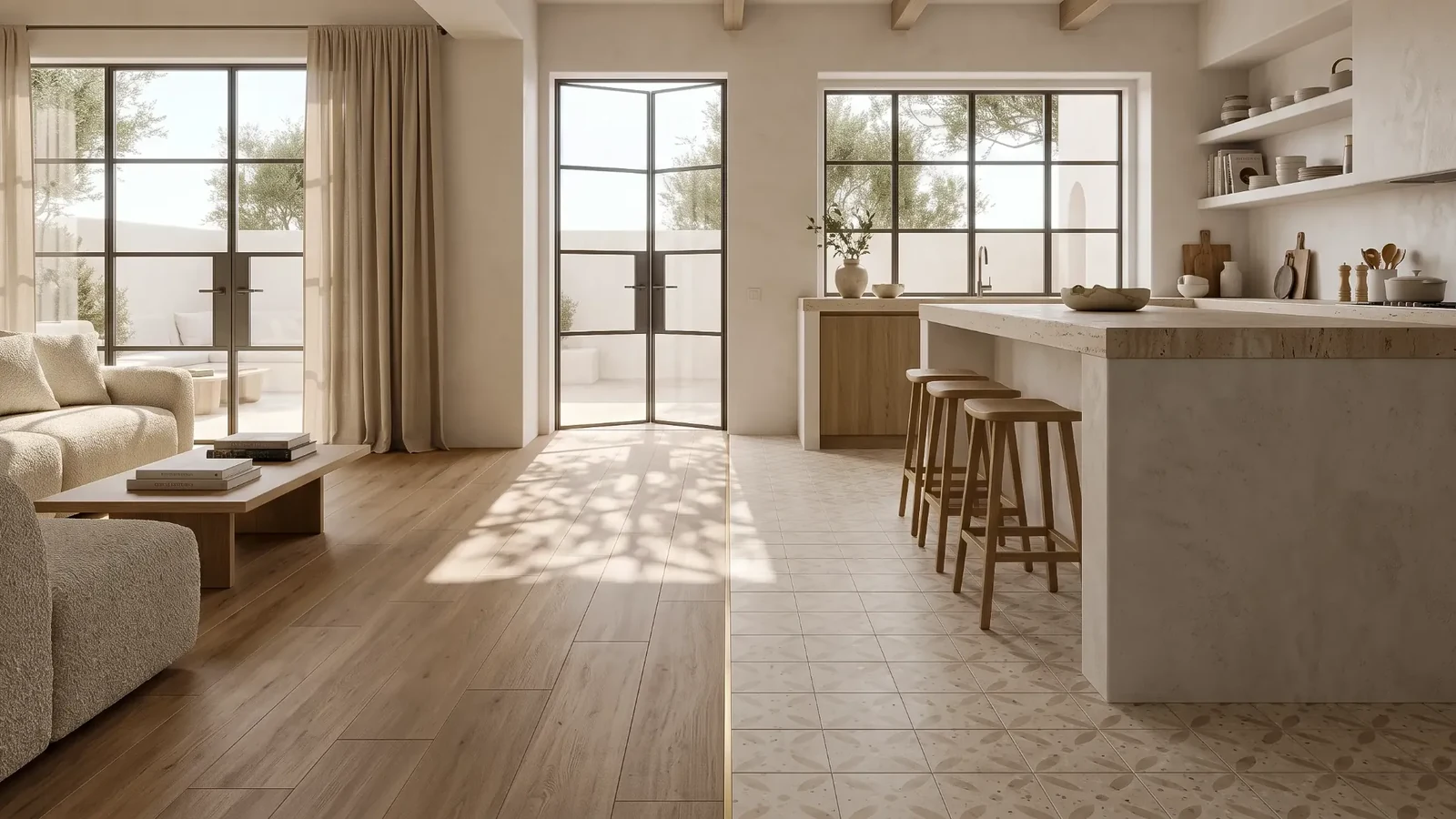
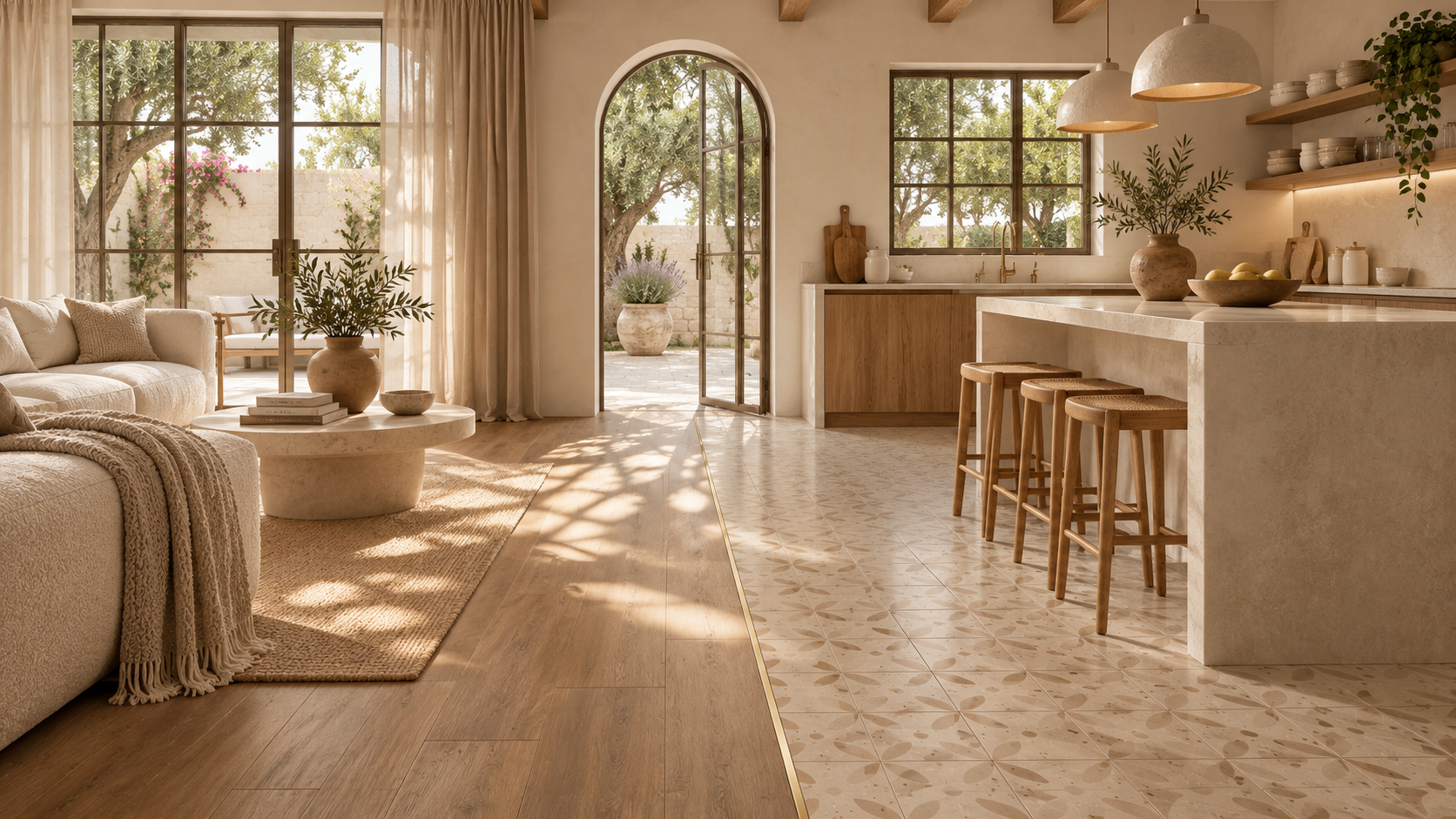
Imagine a kitchen opening onto the living room. There are no partition walls, the windows are the same and light moves freely through the space. But at some point, beneath our feet, the flooring changes texture, format or colour and suddenly, without building a single wall, two distinct areas emerge.
That is one of the things I like most about using ceramics in interior design: their ability to organise a space without physically dividing it.
And although combining floor finishes might seem straightforward, achieving a harmonious result usually involves quite a few decisions.
The quiet appeal of materials that complement one another
Not every combination needs to draw attention to itself. In fact, some of the loveliest are precisely those in which the materials seem to understand one another effortlessly.
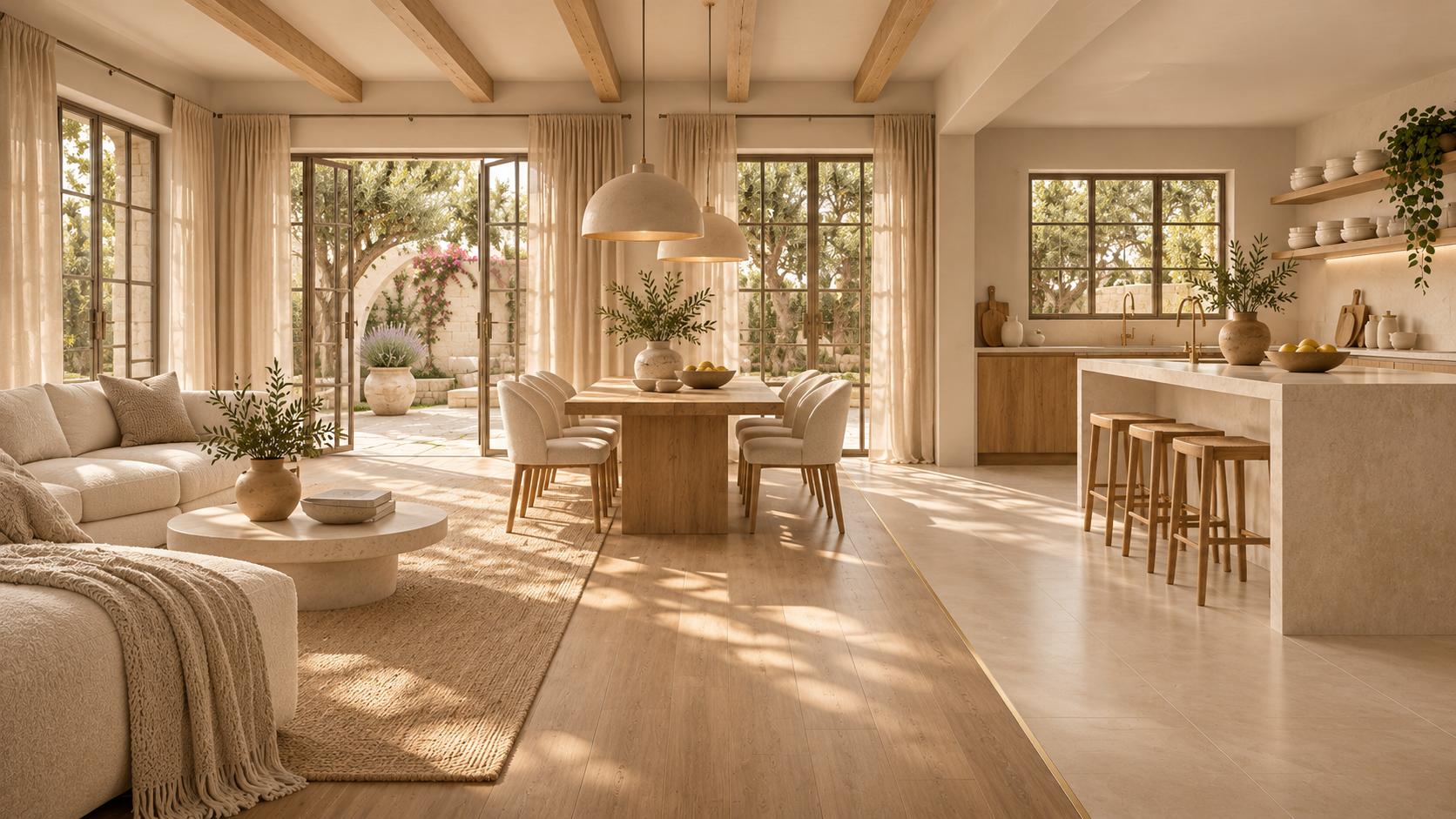
One possibility, for example, is to use wood-look flooring in the living area and reserve a more uniform surface for the kitchen.
The Tabula collection by Geotiles, for instance, recreates the appearance of wood in elongated 20 × 120 cm porcelain tiles. Its Haya and Miel shades can be a starting point for imagining warm interiors, with a visual presence reminiscent of natural timber flooring.
Alongside it, we might consider a more understated surface such as Essenza by Pamesa, a porcelain collection available in neutral shades including Beige, Tortora and Perla.
The combination of these two visual languages, one defined by wood grain and the other by a more even appearance, can distinguish different areas without creating a harsh contrast. Still, choosing two similar shades does not guarantee that they will work together. It is worth examining real samples under the same light, as a beige may have pink, yellow or grey undertones that significantly change how the overall scheme is perceived.
And this brings us to a first idea worth remembering: harmony depends less on two floors being alike than on there being a relationship between them.

When pattern enters the picture
Sometimes we want the exact opposite: for part of the floor to take centre stage. A small kitchen, an entrance hall or even the area beneath a dining table can be the perfect place for decorative flooring. This is where hydraulic-tile-inspired designs come into their own, introducing geometry, repetition and colour.
The Danube collection by Aparici, with its cream-toned backgrounds and geometric motifs, suggests interiors in which pattern has a presence without demanding excessively strong contrasts.
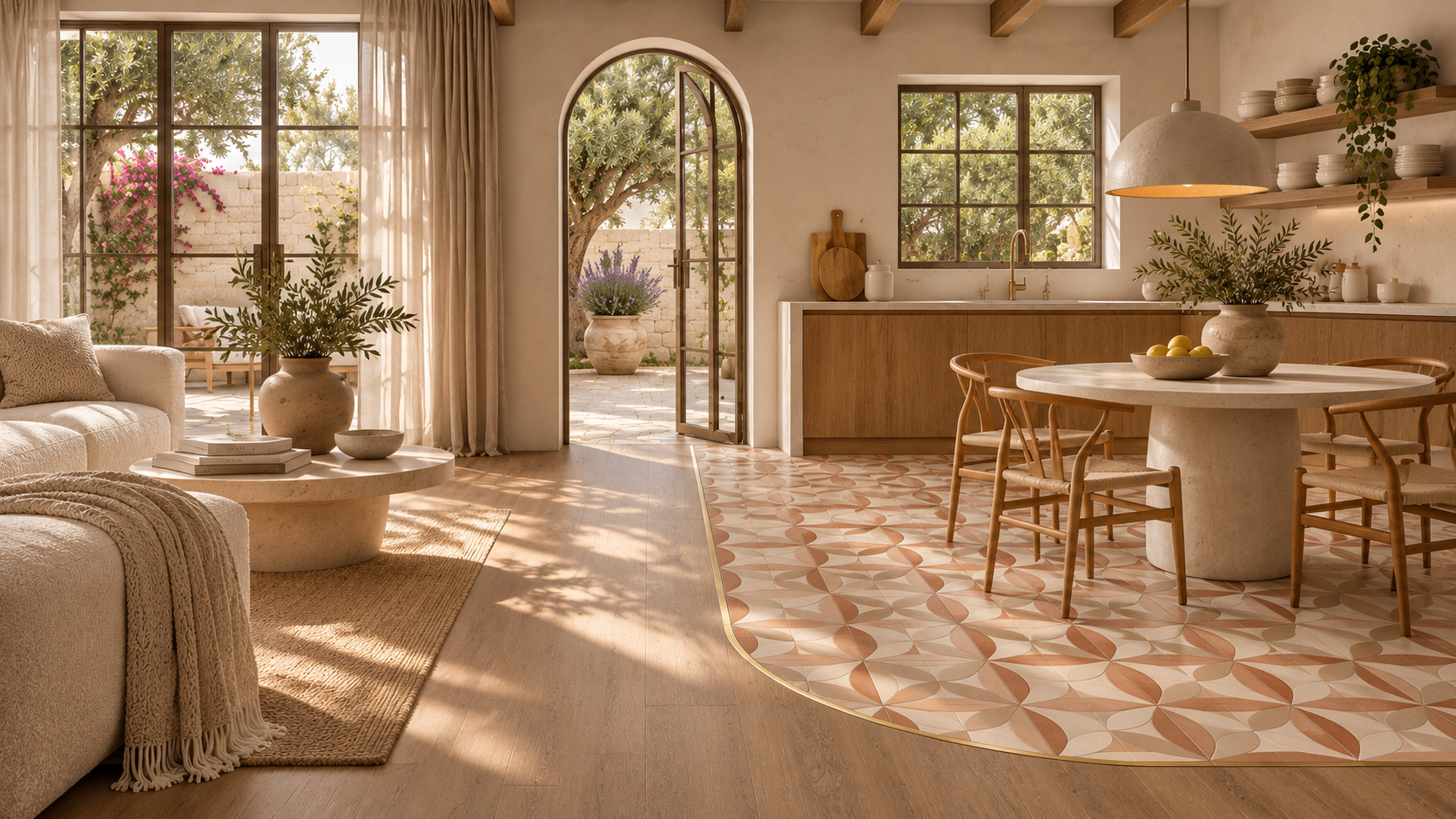
We could use a decorated area to mark out the kitchen and combine it with wood-look flooring in the dining area.
Another, more graphic interpretation can be found in Vodevil by Vives. Its hydraulic-inspired designs, available in a 20 × 20 cm format, make it possible to create compositions reminiscent of traditional floors that can still be found in historic buildings.
I particularly like the idea of using these patterns in limited areas.
There is no need to fill an entire room with motifs for the floor to have personality. Sometimes it is enough to give them a carefully chosen place and let the rest of the surface serve as a backdrop.
The secret lies in finding the point at which pattern adds character without competing with everything else.


The return of terrazzo and surfaces with a memory
Some materials never quite disappear. They simply return to our homes in different proportions, new colours or fresh interpretations.
Terrazzo is one of them.
For decades, it has been part of homes, schools, public buildings and everyday spaces. Today, its appearance is finding a place in interior design once again through collections that recover the visual richness of its small fragments.
FS Venecia by Peronda is a porcelain collection that reinterprets precisely this fine-grained terrazzo aesthetic.
Its visual texture is an appealing alternative for anyone looking for a floor with presence but who would rather avoid more sharply defined geometric patterns.
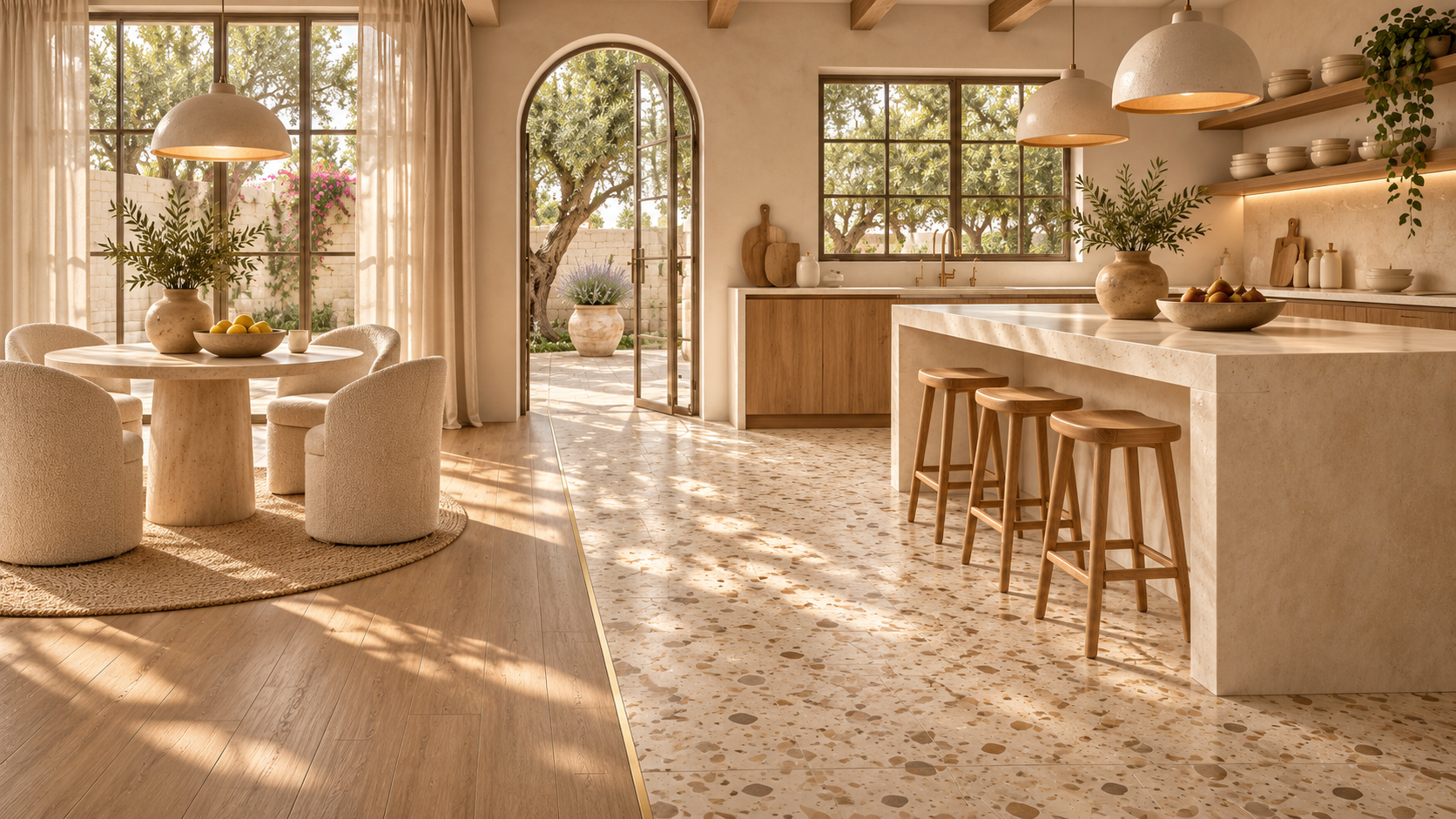
In a contemporary kitchen, for instance, we might imagine terrazzo-look flooring paired with a neutral surface such as Pamesa's Essenza.
The result would depend on the chosen tones and the layout of the space, but the idea has a particular charm: letting one material bring rhythm while the other gives the eye a place to rest.
Because combining does not always mean adding more. Sometimes it is about knowing which surface should lead and which should accompany it.

The transition: a small detail that changes everything
So far, we have talked about materials, colours and atmosphere. But one aspect of the design deserves just as much attention as the choice of flooring: the point where the two surfaces meet.
A straight line can create a discreet, orderly transition; a change in laying direction can guide the eye towards a particular area; and geometric formats can create staggered junctions that bring movement into the composition. Visually, all of them may be interesting, but the challenge comes when it is time to turn the idea into a built reality.
Floors from different manufacturers may differ in thickness, format and dimensional tolerances. Joints, substrates, expected movement and transition profiles must also be considered wherever necessary.
That is why a combination that looks good on paper should not be regarded as resolved until its technical feasibility has been checked.
This matters especially when we mix small tiles with large formats or surfaces that require different installation systems. And here it is worth remembering something else: a visually continuous junction does not mean that necessary joints can be omitted.
Good design is also revealed in those details we barely notice but that allow a solution to keep working over time.
What if both floors are ceramic?
When we talk about mixing flooring materials, we often think automatically of natural wood and ceramic tiles. Yet one of the most interesting possibilities may be to work entirely with ceramic materials that have different appearances.
Wood-look porcelain can sit alongside a stone- or cement-look finish, while a uniform surface can meet a hydraulic-inspired pattern. A terrazzo-inspired finish can bring texture to a room dominated by plain tones.
This variety allows us to explore very different compositions without requiring every material to belong to the same collection. Of course, that does not mean every combination will be suitable: each product must be chosen with its intended use, technical performance and installation conditions in mind.
Where water may be present, for example, it is particularly important to check slip resistance and any requirements that apply to the space.
Aesthetics open up many possibilities, but understanding the material is what allows us to make proper use of them.
Five questions before combining two floors
Before deciding which collections to use, it is worth asking ourselves a few questions.
Do we want to distinguish two areas or preserve a sense of continuity? Should the junction be discreet or become part of the design? Which surface will be exposed to more foot traffic, moisture or wear? How do the chosen colours behave in natural light? And how will the junction between the two floors be resolved technically?
These are not especially complicated questions, but they help put our decisions in order.
It is also worth asking for material samples and placing them side by side, preferably in the room where they will be installed.
Catalogue photographs are wonderful tools for discovering possibilities, but light, texture and colour can look quite different when the actual tiles are in front of us. These days, AI tools can also help us create our own visual compositions and decide whether we like an idea,
A home tells its story through the floor, too
Perhaps the loveliest thing about combining floors is discovering that a surface can do much more than complement the furniture.
It can mark a transition, revive an architectural reference, bring warmth, introduce an unexpected pattern or allow two areas to share one space without losing their individuality.
The collections by Aparici, Peronda, Geotiles, Vives and Pamesa we have explored are only a few of the possibilities offered by contemporary ceramics.
There is no universal formula for combining them. And perhaps there would be little point in looking for one: every home has its own light, proportions and particular way of being lived in.
In the end, it is about choosing materials that work together and have something to contribute to the space. Because sometimes a home begins to tell its story with the very floor beneath our feet.
THE CONVERSATION
The conversation continues.
A story continues with what you have to say. Comment on the article as a whole here; remarks on photographs belong in “A Second Look”.
No general comments yet. Start the conversation.